
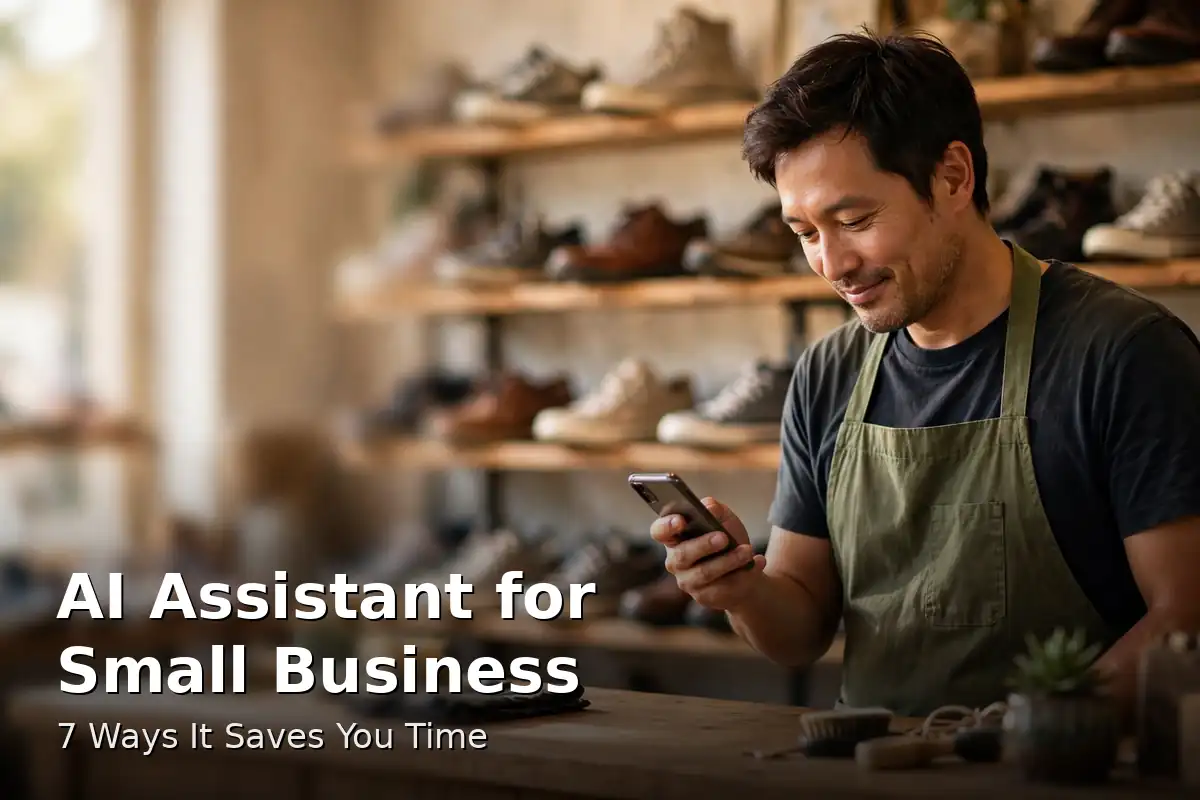
How an AI Assistant for Small Business Handles Your Daily Messages
The kettle went on, October fans still running at full, and while the water boiled I made the mistake of opening WhatsApp.
The screen showed twenty three, every one of them unread. I ran through them a second time, with an ai assistant for small business, because the first count had annoyed me too much to believe.
Two from suppliers. Twenty one from customers. And if you are wondering, no, nothing new hid in any of them. Same questions returning with same answers, a tune on repeat since 2019 that nobody requested twice. One message held a single word, price? Another wanted size 42. A third was stuck on delivery charges.
If your business is a salon or a workshop, or you do someone’s accounts from a laptop that migrates between the kitchen table and the cot, your morning is my morning wearing different clothes. Messages. Then small jobs riding on their coat tails. Then you, the supposed owner, running behind both.
It Was Never About the Customers
My honest diagnosis after some years of this: the problem was never customers. Customers are the whole point, customers pay the electricity bill. The problem is hours. Hours. Hours are fixed, they do not negotiate, and no productivity guru on YouTube has ever manufactured a twenty fifth one.
People ask me, does an AI assistant for small business actually change anything? I say yes, it changes plenty, but it will not perform miracles and it will not do your thinking for you. What it does, and this surprised me, is swallow the dull half of the day. The typing. The same reply for the fortieth time.
The let me check and come back to you business that nibbles your afternoon to death in bites too small to notice.
The Numbers Back It Up
There is research behind this, it is not only my own observation. Thryv asked 540 small business owners in 2025, and among those already using AI, 58 percent said it hands them back more than 20 hours a month. Twenty hours is nearly three working days, I did that math on a bill book.
The US Chamber says 58 percent of small businesses now use generative AI in one shape or another, up from 40 percent a year before. Notice who is leading. Not the giant chains with IT departments. Our lot wakes while the sun is still deciding, kettle done, phone glowing since last night.
The Assistant in Everyday Words
Talk to it, an ai assistant for small business, the way you would talk to a person at your counter. That is the whole trick. Normal words, no commands to learn by heart, no brick-sized manual. You type, write a polite reply to this customer, and it is done.
You paste a supplier catalogue, thirty pages of boredom, and ask what changed since last month, and that is also done, with the changed prices actually listed.
Ask someone what an AI chat assistant is and they will describe exactly this, something with zero resemblance to those awful old chatbots from 2020, fixed menus and all, the kind we all tried once and abandoned before our tea cooled.
It, an ai assistant for small business, follows your meaning, it has not forgotten the delivery charges from two messages earlier, and a sentence that falls apart halfway gets no punishment from it.
Seven jobs it takes off owners. I have watched it happen in my own business and in two friends’ businesses, so this list is not theory.
One. The same customer questions, asked forever.
A man messaged me last Thursday at 9:03 in the morning. Sir, is this design in stock? The message passed before my eyes while I was lifting the shutter. I thought, just five minutes, let me open the shutter fully first.
Then the loader arrived early for once in his life, then a family walked in wanting school shoes for three children, then the power went out, and the UPS started its cheep cheep like an offended bird. When I finally replied, nicely, with sizes, price, everything, it was 1:47. He wrote back one line. Got it from another shop, brother.
Four words. Sale gone, not because my price was wrong or my shoes were bad. Because my reply was four hours late.
That is why the ready drafts live in my phone now. Price, delivery charges, timings, the ten questions that arrive every day. Anything odd, I paste the man’s words in, the ai assistant for small business writes the reply, I read it with my own eyes once, send. Ten seconds.
The old way was three minutes and occasionally a lost customer standing in someone else’s shop. Thryv found 46 percent of businesses using AI use it exactly here, on customer engagement, and honestly that number feels low to me.
A word of caution here, and I paid a small price to learn it: read the draft from an ai assistant for small business once before it leaves your phone. Double that care when the customer is already fuming, or when a refund is on the table.
Fire off a lovely promise that happens to be wrong, to a man who is already furious, and congratulations, you have just set light to something with your shop name on it.
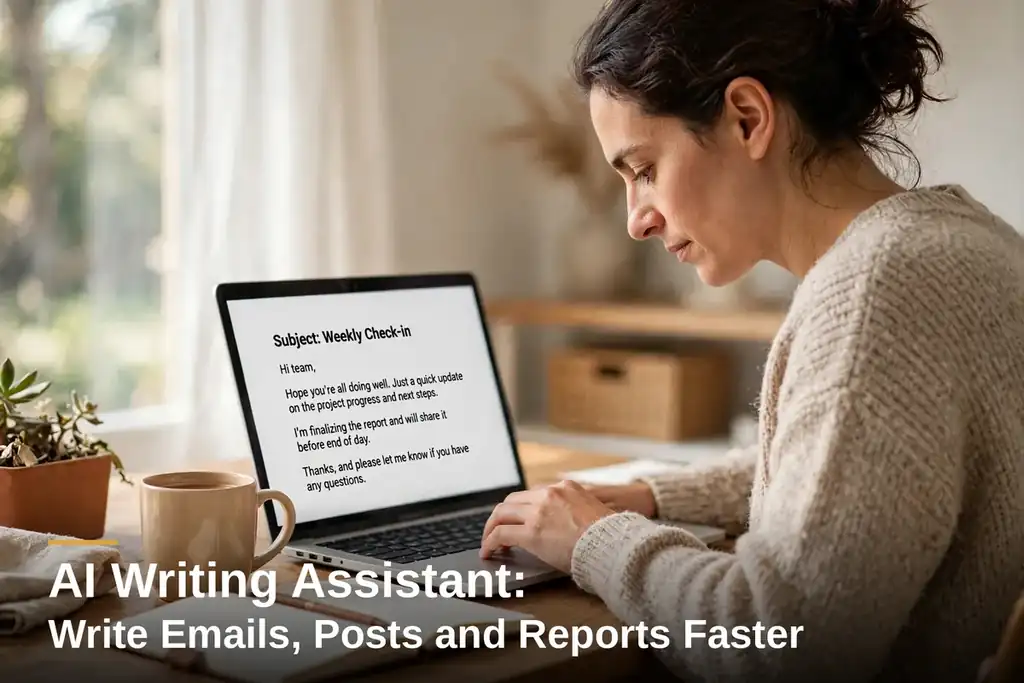
Two. Writing, the job everyone postpones.
Ask any owner. He does not hate writing. He hates starting. Picture eleven at night. Blank screen. A cursor doing its tube light impression, flickering on a loose connection, while an email sits fully written in his head, minus, somehow, its opening line.
Hand the ai assistant for small business four details, and the draft is there before your eyes have finished reading the sentence, and fixing a draft takes two minutes of work, while starting cold takes twenty minutes plus feeling sorry for yourself. A quotation. A firm, polite, tired reply to a supplier who is late for the third time.
A description for the new stock. The tone is sometimes off, it will write one sentence you would never say at gunpoint, fine, cross it out, that is editing, editing is easy. And for this level of writing a free ai assistant for small business genuinely covers the bill. Nobody needs it to read like literature.
Clear, polite, and actually sent, that is the whole standard. If you want the cleanest example I have, look at product descriptions. A fresh batch comes in, forty pairs, the photos are all in my phone, and my head holds nothing at all, zero, blank.
I tell it, an ai assistant for small business, what kind of shoe it is, who actually wears it, college boys, office men, a couple of points worth mentioning, and a paragraph comes out that I can stick under the photo before the cartons are even stacked. Eighty percent my voice. The rest, well, that is me anyway.
Three. Information. Research.
Rates in my line move like the weather in Murree. A competitor puts up a sale banner the same week my cash is stuck in stock. A customer asks about a brand I have never kept and I have until evening to decide if it is worth a phone call.
The old way was fifteen tabs open on a slow connection and a headache, ending, regularly, in no decision at all. Now I simply ask. So I ask three things: who is bringing this in from Lahore, where the rate stands right now, and what exactly people are complaining about under that other brand’s reviews?
It, an ai assistant for small business, roots through the pile, leaves a short summary in plain sight, and my mind is made up before the tea cools off. Do I gulp down every line it returns? Thank God, I am not that gullible.
When real money is leaving my hand I verify the big fact myself, the same way I recount cash from my own counter boy. But the daily questions, the ones posted in front of every small decision like toll booths, those it sweeps aside, and my guess is it hands me back an hour a day I used to burn in tabs.
Four. A Mountain of Paperwork
Nobody told me before I opened the business that half of life would go to paperwork. Price lists, where the one condition that matters is printed at the bottom in a font made for ants. Agreements. Invoices narrating themselves for six pages. Government letters in that special English that slides off the eyes.
Nowadays the file goes up and gets a proper grilling, like a man across the counter who suffered through the whole miserable document twice and returned with a list of questions. The payment terms need spelling out in words I actually use, the expiry date printed somewhere my eyes can find it, and one honest answer: what exactly has to happen before Friday?
A supplier sent a price list PDF last month so heavy it could prop a door open in a storm. Forty items. Forty different rates. Conditions hiding down in the footnotes.
I asked two questions of an ai assistant for small business, which items crept up since last month, and what is the minimum order for free delivery, and the answers came back standing straight on the screen. Reading that document properly would have cost me half an hour of a quiet shop, and my shop is never quiet, it has a load shedding schedule instead.
The main points took under a minute with an ai assistant for small business. I read the two pages that concerned my money and ignored the rest with the pride of a man who has finally won one.
Five. The list inside my head.
For years my to do list lived nowhere except inside my head, and my head, sorry to say, was never built to file things. It was a trouser pocket, nothing more. Trouser pockets drop things on their own schedule, they never once ask you.
Give it, an ai assistant for small business, a quiet day and the whole lot makes it through to nightfall. Give it a rush day and three items slip out in silence, then Friday afternoon comes along to report what Tuesday lost. Tuesday has never once said sorry.
So the list lives in the ai assistant for small business now. I dump the whole messy, untidy pile in and receive a plan back, morning shaped.
After a supplier meeting I mutter my half-finished notes into it and receive proper action points, names included, instead of my usual midnight archaeology through month-old chats, trying to recall who promised what to whom. Written down, that reads like a tiny change. In actual life, it is far from tiny.
Our stress is seldom one huge disaster. It is fifty little things humming loose around your ears all day, like a fly at a picnic nobody planned.
Six. The jobs that repeat like a stuck record.
Morning accounts. The routine report. That one stock check that must happen daily, because the day it skips is the day things go wrong, a law I did not write.
Plenty of assistants will run these on a schedule now. The work happens whether your memory shows up or not, which is, if we are being honest, the entire appeal. You set it up on one calm afternoon, then you check its output the way you check a counter boy counting, quickly and with love but checking. Start embarrassingly small.
One automation. Ten minutes saved a day sounds like a joke told by a man selling something, until you multiply it by a month and find a whole working day hiding inside it. Mine is a morning summary. Yesterday’s messages, yesterday’s orders, and anything urgent sits at the top, where a half-asleep man can still spot it.
It, an ai assistant for small business, shows up while the kettle sings. Nothing grand lives in it, no polish, and that is exactly why it survives six months on while my fancy systems died.
Seven. Thinking Before Money Moves
Should this new line go on the shelves or not? Take this special offer. Genuinely special, or last month’s offer wearing a red sticker and a confident face? Say I finally start home delivery properly. What is the smallest possible first version, the kind that leaves the month alone?
An ai assistant for small business deciding these things for me, I would not trust it, and I would not trust a human who offered either. What it does well, strangely well, is cleaning up the thinking. Pros here. Cons there. Two options side by side like shirts on a bed, pick.
And it, an ai assistant for small business, asks the question we owners avoid saying aloud: what are you not seeing here, before this cash walks out and becomes a story? I have made decisions at 1 in the morning with my brain spinning like a ceiling fan, and at 9 with a clean list in front of me. Same brain.
Same brain, completely different decisions walking out the door.
Now, the Money Part
Less than people assume, and I include my earlier self among the people. A free ai assistant for small business is the place to start, zero to pay, ropes learned whenever you have a spare half hour. Paying owners, when they do pay, usually run into a proper AI assistant app carrying a price tag of 10 to 30 dollars a month. Translate that into shop language.
That is less than a part time helper takes for one day, and the helper, quite rightly, expects food. If a tool hands you five hours a month, it has paid its own rent and left change on the counter. If it hands you nothing, cancel. Finished.
No contract is hiding in a drawer with your signature hostage.
Our own tool, Nova Agent, an ai assistant for small business, is built on this thinking. Chat, web research, space to work with your own files, the free plan holds all three.
The paid side starts at ten dollars a month for an ai assistant for small business. Limits climb, models increase, memory begins following you between chats. Sounds like brochure copy, I know, until the morning it brings up your supplier rate before you ask.
The deeper detail is on our AI assistant services page, sitting there for anyone curious enough.
Time to Pick One
Decent people freeze exactly at this point, the choosing point, because dozens of ai tools for small business swear they will hand you the same moon, just in different fonts. My advice, ignore the marketing and judge it on your biggest time waster. If messages are eating your day, the tool lives or dies on messages, full stop.
One real job of your own with an ai assistant for small business tells you more than any demo performed by a calm man with no loader parked outside his shutter. Run the free plan on real work for two weeks, not five minutes of clever test questions followed by a verdict.
Look into what it, an ai assistant for small business, does with your data as well. Business information is yours, the way the cash drawer is yours, and that alone makes the privacy policy worth an early read. Any tool you have not checked out first never sees a customer’s sensitive details. Two minutes to vet, a whole year to panic. One habit beats the lot: a single roof over everything.
Give a single ai assistant for small business your chats, projects, and files, and five one-job apps with their monthly bills and constant jumping start looking pointless.
Begin small. Begin this week. Pick the sleep-stealer off this list, if one exists, and keep an ai assistant for small business beside you on it for a week. Hours wander back, the assistant stays put, fresh jobs turn up, roots settle in quietly.
If nothing comes back at all, a few minutes are gone and a straight answer is gained, and straight answers run rarer in business than honest scales.
Small businesses never win by working extra hours. Extra hours do not exist, and that was the entire complaint this article opened with, if you kept score at home. We win by spending the hours we actually have on the work that counts. The typing, the repeating, the digging through paper, that is all the assistant’s job.
It is all it has ever been for.
Frequently Asked Questions
Which jobs does an AI assistant for small business take off an owner’s shoulders, in real life?
Paint the picture and you get a helper standing beside the counter. Through all this time, tea went unasked for, nobody dozed off mid-job, and question forty got an answer just as calm as question one. Back from my keyboard comes my own voice across the counter in the morning rush, plain words, no codes, finished work returning. A reply. A summary. A list sorted into morning shape. The decisions stay mine. The typing stops being mine.
Every month, what will an AI assistant cost someone like me?
I began at zero, with nothing paid at the very start. The free plan covered my writing and my daily questions for months. Later, if you want more, paid plans sit around ten to thirty dollars a month, which in shop terms is less than a part time helper takes for a single day, and the helper, quite rightly, expects food. My test runs simple, five hours won back inside one month means the thing covers its own rent.
Is technical knowledge needed before I start using an AI assistant?
Engineering was never my subject, shoes were my living, and still the whole thing runs off my own phone. If you have sent a WhatsApp message at midnight while half asleep, that alone proves you know enough. In most cases you install nothing at all, and no technical setup sits waiting for you afterwards. I still use the same words I used on my first day, the plain words that come out when a customer is in front of me and they have never failed me yet.
If the reply came from a machine, would my customers notice?
They will, the day you send a draft without reading it. I never let that happen. I read every draft once before it leaves my phone. That one read keeps the tone mine and stops wrong promises. That same read also catches the expensive mistakes, a price typed wrong, a promise I cannot keep, a pretty sentence that happens to be untrue. The machine writes the draft. Anything that leaves this place carrying my shop name has its decision made by me alone.
With an AI assistant, how safe does my business data stay?
This one depends on the tool, and I say that plainly because I have seen tools that treat your data like their own stock. Before I trust one, I read its privacy policy the way I read a supplier’s terms before signing. What does it store. How does it use what it stores. Business information is yours, the way the cash drawer is yours. Stuff that is sensitive stays well clear of every tool my own eyes have not gone over first.
This week itself, what first step starts me using an AI assistant?
Fixing your whole business on one Monday morning is not the way to begin. I tried that road, it ends with nothing fixed and a headache. Pick one job, the one that steals your sleep, and give the free plan seven days on that job alone. Mine was messages. A week later I knew exactly what it was worth to me, and knowing is better than guessing.




Leave a Reply